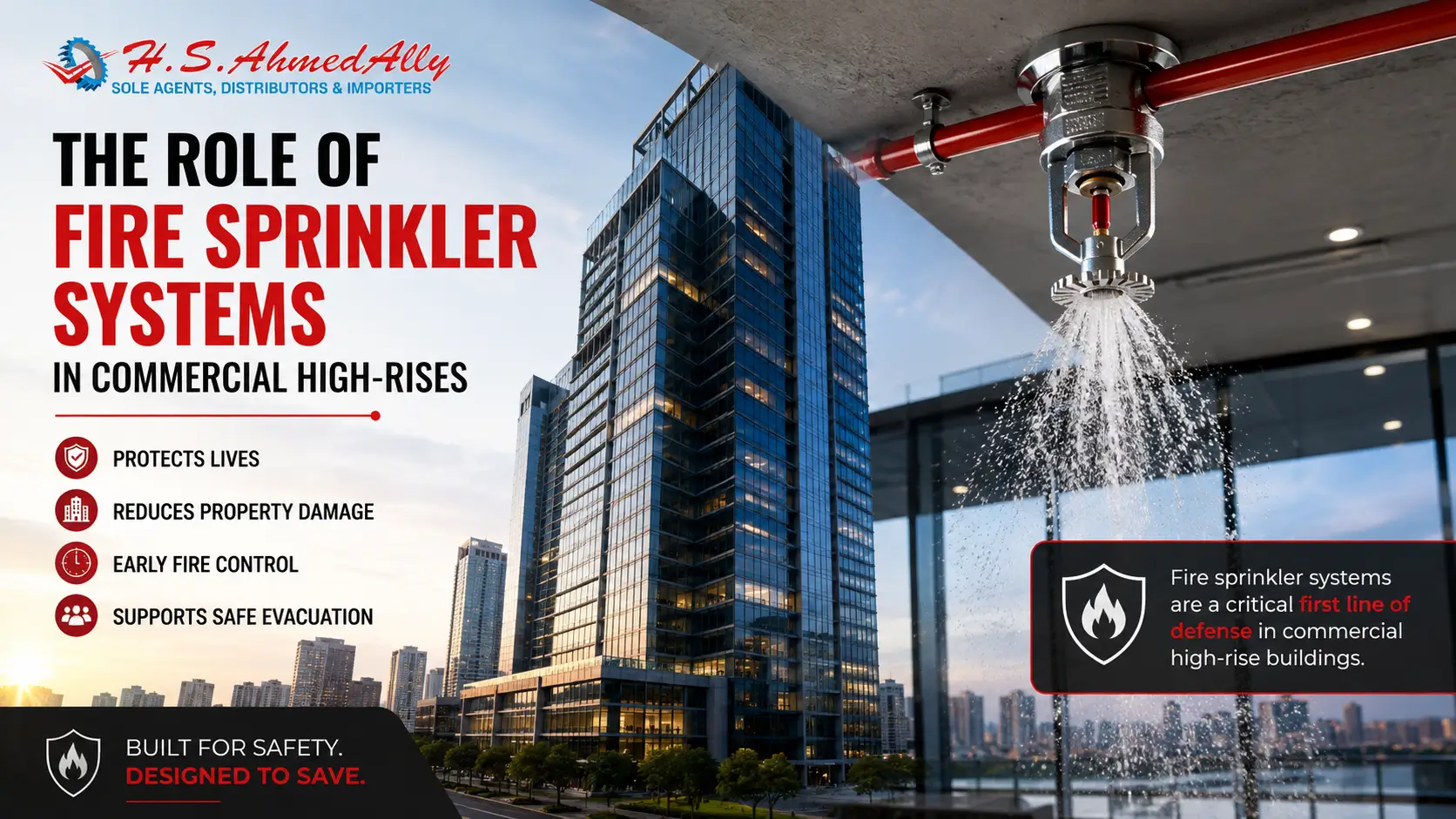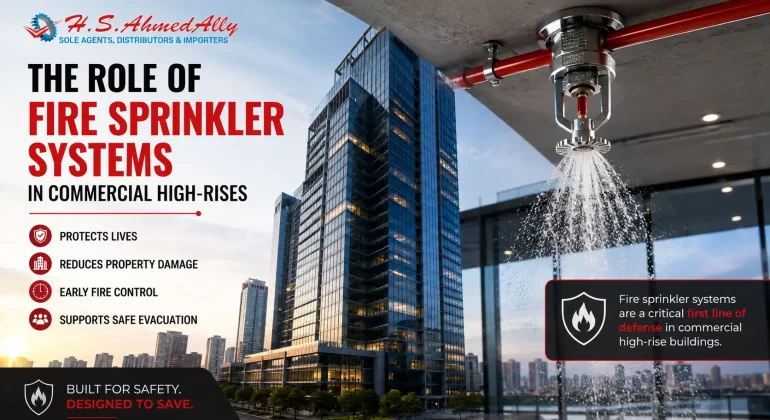

Tall buildings change the rules of fire safety. In a two-storey shop, people can walk outside in under a minute. In a twenty-storey office tower, that same walk can take ten minutes or more, especially if the lifts shut down and everyone has to use the stairs. That gap in time is exactly why fire sprinkler systems matter so much in commercial high-rises.
If you manage, design, or build high-rise properties in Karachi, Lahore, Islamabad, or anywhere else in Pakistan, this guide will walk you through what fire sprinkler systems do, how they work, and why they’re treated as essential rather than optional in tall buildings.
Why High-Rise Buildings Face Bigger Fire Risks
A fire behaves differently once you stack floors on top of each other. Here’s why height changes everything:
- Evacuation takes longer. Stairwells can only move people so fast, and in a real emergency, lifts are usually taken out of service.
- Smoke rises. Heat and smoke travel upward through stairwells, shafts, and gaps around pipes and cables, a phenomenon often called the “stack effect.” This means people on upper floors can be at risk from a fire that started far below them.
- Fire crews take time to respond. Even with a fast response time, ladders and hoses can only reach so high. Above a certain floor, firefighters have to fight the fire from inside the building, not from the street.
- More people, more belongings, more risk. High-rises pack a lot of occupants, furniture, wiring, and equipment into a single structure, giving a fire more fuel and more potential victims.
Because of all this, high-rise fire codes around the world, and increasingly in Pakistan too, treat automatic fire sprinkler systems as a core requirement rather than a nice-to-have. A sprinkler system doesn’t wait for a person to notice a fire and pull an alarm. It reacts on its own, at the exact spot where the fire is, within moments of it starting.
How a Fire Sprinkler System Actually Works
Despite what movies show, a real fire sprinkler system doesn’t set off every sprinkler head in the building the moment one fire starts. That’s a common myth, and it’s worth clearing up early.
Here’s what really happens:
- Heat from a fire rises and reaches a sprinkler head.
- Inside that sprinkler head is a small glass bulb filled with liquid, or a similar heat-sensitive element, designed to react at a specific temperature.
- Once that temperature is reached, the bulb breaks and water is released from that one sprinkler head, and only that one.
- Water flowing through the pipe network triggers an alarm check valve, which sounds an alarm and can also signal the building’s fire alarm panel.
- The system keeps discharging water at that spot until the fire is out, or until someone shuts the valve manually.
So a fire on the 8th floor typically only sets off sprinklers on the 8th floor, right above where the heat is. This targeted response is exactly why sprinklers are so effective at limiting fire damage and stopping fires from spreading to other floors.
Real-world fire data backs this up too: buildings with properly installed and maintained sprinkler systems see dramatically better outcomes than buildings without them, both in terms of lives saved and property damage avoided.
The Sprinkler Heads You’ll Find in a High-Rise
Not every part of a building uses the same type of sprinkler head. High-rise projects usually mix a few different types, chosen based on the ceiling type and how the space is used.
- Pendent sprinklers hang down from the pipe and spray water downward in a wide pattern. These are the ones you’ve probably seen in office ceilings, hotel corridors, and retail floors.
- Upright sprinklers sit on top of the pipe and spray upward against a deflector plate. They’re a common choice for open ceilings, plant rooms, and parking basements, where there’s no false ceiling to hide the pipework.
- Sidewall sprinklers are mounted on a wall instead of the ceiling and spray outward in an arc. These are useful in corridors or rooms where running pipe across the ceiling isn’t practical.
- Concealed sprinklers sit behind a flat cover plate that drops away when heat builds up. Architects like these for high-end interiors, since they blend into the ceiling until they’re actually needed.
Choosing the right mix of heads isn’t just about looks. It’s about matching the sprinkler to the ceiling height, the layout, and the type of hazard in each part of the building. A full breakdown of the heads and components available is on our product page of the fire sprinkler system.
The Parts You Don’t See: Valves, Switches, and Zones
A sprinkler head is only one piece of the puzzle. Behind the walls and above the ceiling, a network of valves and switches keeps the whole system working correctly and lets building staff know exactly where a problem is happening.
- Alarm check valves sit at the base of the system and hold water pressure steady. The moment water starts flowing because a sprinkler has activated, this valve triggers the alarm.
- Flow switches are placed at each floor or zone. They detect water movement in that specific section of pipe, so the building’s fire panel can tell staff exactly which floor triggered the alarm, not just that “a sprinkler went off somewhere.”
- Zone control valves let a specific floor or section be isolated for testing or repair, without shutting down protection for the rest of the building.
In a tall building with dozens of floors, this zone-by-zone design is what makes the difference between a confusing false alarm and a clear, fast response. It also means maintenance teams can service one floor at a time without leaving the whole tower unprotected.
Standards That Matter: NFPA 13 and Local Compliance
Sprinkler systems aren’t something you can design casually. In Pakistan, as in most countries, they’re expected to follow NFPA 13, the internationally recognized standard covering how sprinkler systems should be designed, spaced, and installed. This standard sets rules for things like how far apart sprinkler heads can be, how much water pressure the system needs, and how pipes should be sized for different hazard levels.
Beyond the technical standard, high-rise buildings in Pakistan also need to satisfy local Civil Defence requirements and building bylaws before they can be occupied. Insurance providers often ask for proof of a properly designed and certified sprinkler system too, since a compliant system directly reduces the risk they’re taking on. Getting this right from the design stage saves a lot of pain later, when a building is trying to pass inspection or renew its insurance.
Sprinklers Are One Part of a Bigger System
Here’s something worth understanding clearly: a sprinkler system doesn’t work alone. In a well-designed high-rise, it’s just one layer in a stack of protections that work together.
- Fire pumps supply the water pressure sprinklers need, especially on upper floors where gravity and building height can reduce natural water pressure. Without a properly sized fire pump, even a perfectly installed sprinkler system can’t deliver enough water where it’s needed.
- Fire detection and alarm systems often work alongside sprinklers, giving an earlier warning through smoke detectors, and coordinating evacuation before a sprinkler even needs to activate.
- Fire extinguishers give occupants a way to tackle a small fire by hand, in the short window before or alongside automatic systems responding.
- Fire doors hold back fire and smoke between compartments, buying extra time for people to reach stairwells safely, and stopping a fire on one floor from racing across the whole building.
- Emergency lighting systems keep stairwells and exit routes visible if the power fails, which matters most in exactly the kind of emergency a sprinkler system is responding to.
Some spaces in a high-rise, like server rooms or electrical switch rooms, need a different kind of protection entirely, since water could damage the equipment being protected. For those areas, a clean agent fire suppression system is usually the better fit, working alongside the sprinkler network rather than replacing it. To learn more more, here’s our guide on fire suppression system for IT server rooms.
Seen together, these systems form what fire engineers call a layered approach: detect early, alert people, hold back the fire physically, put it out automatically, and light the way out. Sprinklers are the layer that actively fights the fire itself, which is exactly why they’re treated as one of the most important pieces of the whole picture.
Why Sprinkler Maintenance Can’t Be Skipped
A sprinkler system that hasn’t been tested in years is a risk hiding in plain sight. Corroded pipes, stuck valves, or a blocked flow switch can all mean a system fails silently, with no way to know until it’s actually needed, which is the worst possible time to find out.
Routine checks typically include testing alarm valves, checking that flow switches respond correctly, confirming sprinkler heads haven’t been painted over or damaged, and making sure water pressure stays within the range the system was designed for. Most codes call for this kind of testing on a regular schedule, not just once at installation.
For property managers running a high-rise, building this into a routine maintenance plan, rather than treating it as a one-time installation task, is what keeps the system reliable for the life of the building.
Getting It Right From the Start
A fire sprinkler system is only as good as its design and installation. Getting the water pressure calculations wrong, spacing heads incorrectly, or mixing incompatible components can leave a building with a system that looks complete but won’t perform when it counts.
At H.S. Ahmed Ally, we supply genuine, certified fire suppression systems and components for commercial and high-rise projects across Pakistan, backed by technical support for consultants and contractors working through the design and BOQ stage. You can browse the full range of sprinkler heads and system components on our Fire Sprinkler System page, or see how sprinklers fit alongside our wider fire fighting product range.
If you’re planning a high-rise project and want guidance on system design, compliance, or sourcing, get in touch with our team. We work with consultants, contractors, and building owners across Karachi, Lahore, Islamabad, and beyond, to make sure fire protection is handled properly from day one.
FAQs on Sprinkler Systems for High-rise Buildings
Do all the sprinklers go off at once?
No. Only the sprinkler head closest to the heat activates. The rest of the building’s sprinklers stay untouched unless the fire actually spreads to their zone.
Can a sprinkler system go off by accident?
It’s rare. Sprinkler heads are built to react to real heat, not smoke, steam, or cooking fumes, so false activations from everyday building use are uncommon when the system is installed and maintained correctly.
Do high-rises in Pakistan legally need sprinkler systems?
Requirements vary by city and building type, but Civil Defence departments and building bylaws increasingly expect sprinkler protection in commercial high-rises, especially above a certain floor count. Insurance providers often expect it too. It’s always worth checking the specific requirement for your project with your local authority or fire consultant.
How long does a sprinkler system last?
With regular testing and maintenance, sprinkler components can stay in service for decades. The parts that tend to need attention over time are valves, gauges, and any sprinkler heads that get painted over, blocked, or physically damaged during renovations.