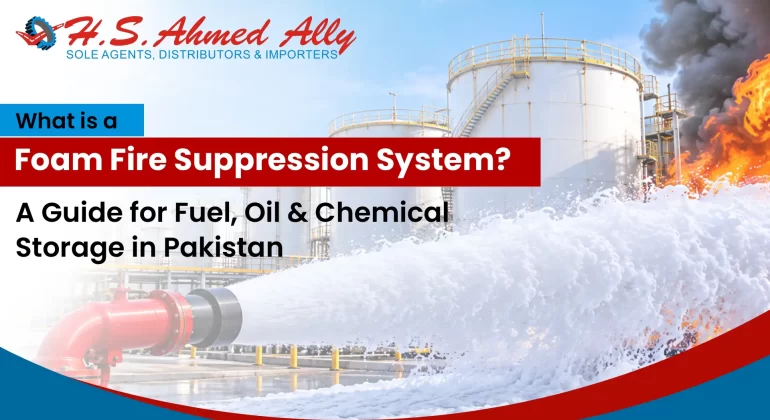

Fuel and oil fires are a different kind of fire. They spread fast. They burn hot. And they do not behave the way a paper or wood fire does.
If your site stores petrol, diesel, furnace oil or chemicals, you need a fire plan built for liquids. In most cases, that plan includes a foam fire suppression system.
This guide explains what a foam system is, how it works, and what it is made of. It also covers where foam is used in Pakistan and how to pick the right setup. We keep the language simple, so you can use it whether you are a plant manager, a safety officer or a business owner.
What Is a Foam Fire Suppression System?
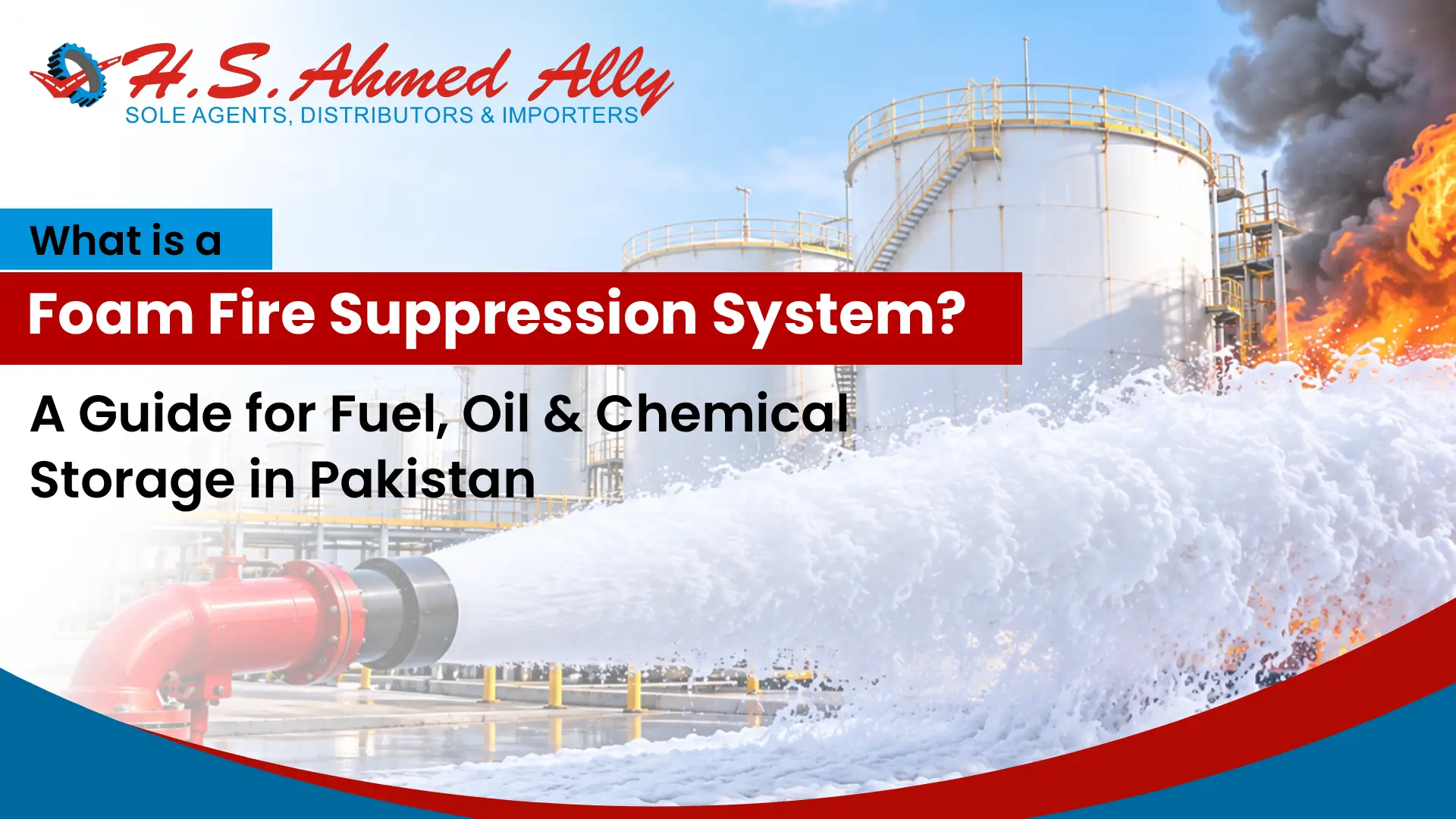
A foam fire suppression system is a fixed or portable setup that makes fire fighting foam and delivers it onto a burning liquid. The foam spreads across the surface. It forms a thick blanket. That blanket cuts off the fire’s air supply and cools the fuel.
Fire fighting foam is made from three things:
- Water
- Foam concentrate (a liquid that is mixed into the water in small amounts)
- Air (added at the nozzle or foam maker, which creates the bubbles)
Mix those three together in the right ratio and you get foam. The foam is lighter than oil or petrol, so it floats on top. That is exactly what you need when the fire is on the surface of a liquid.
In short: a foam system is the equipment that stores the concentrate, mixes it with water, adds air and sprays it where it is needed.
Why Water Alone Does Not Work on Fuel and Oil Fires
Many people think water puts out every fire. It does not.
Fires fall into classes. Wood, paper and cloth fires are Class A. Fires that involve flammable liquids, such as petrol, diesel, oil and many chemicals, are Class B. Water is the wrong tool for most Class B fires, for three reasons:
- Oil and petrol float on water. The burning liquid just rides on top and keeps burning.
- Water can spread the fire. A stream of water can push burning fuel across the ground, or out of a tank bund.
- Water does not stop the vapour. The flames are fed by fuel vapour rising off the surface. Water alone does not seal that vapour in.
Foam solves all three problems. It floats. It covers. It seals. That is why foam is the standard answer for flammable liquid storage.
How Foam Puts Out a Fire
Foam does four jobs at once:
- It smothers. The foam blanket blocks oxygen from reaching the fuel.
- It cools. The water in the foam draws heat out of the liquid and the surrounding metal.
- It suppresses vapour. The blanket traps the vapour so it cannot feed the flames.
- It separates. The foam acts as a barrier between the flames and the fuel.
Some foams, called AFFF, also form a thin watery film on top of the fuel. This film spreads fast. It helps knock the flames down quickly. Then the thicker foam blanket stays in place and helps stop the fire from starting again. Fire teams call that restart “re-ignition” or “burn-back.”
Speed matters here. A tank fire that is hit early with foam is far easier to control than one that has been burning for an hour.
The Main Parts of a Foam Fire Suppression System
A foam system has several parts. Each one has a job. If one part is missing or weak, the whole system suffers.
1. Foam concentrate
Foam concentrates are the liquid that makes the foam. It is stored in a tank, drum or pressure vessel. Different concentrates suit different fuels. We cover the types below.
2. Water supply and fire pump
Foam needs a lot of water. You need a steady supply, such as a storage tank or reservoir. You also need a fire pump that can push that water through the system at the right pressure. If the pump fails, the foam fails. Our Fire Pump Buying Guide for Businesses in Pakistan explains how to pick a reliable one, and you can browse our range of Firex fire pumps.
3. Proportioner (the mixer)
The proportioner mixes the concentrate into the water at the correct ratio. A 3% system adds 3 parts of concentrate to 97 parts of water. A 6% system adds 6 parts to 94. Get this ratio wrong and the foam will be weak or wasteful.
4. Discharge devices
These are the parts that put the foam on the fire. Common types include:
- Foam chambers on the top of storage tanks
- Foam monitors (large, aimable nozzles) for open areas and tank farms
- Foam nozzles and branch pipes for hand-held hoses
- Foam sprinklers or deluge heads for loading bays, pump rooms and process areas
5. Piping and valves
Pipes carry the foam solution from the mixer to the discharge point. Valves control the flow. Good design keeps pressure steady and the foam quality high.
6. Detection and control
Fast detection saves tanks. Flame detectors, heat detectors and manual call points can trigger the system or alert the operators. See our Fire Detection Alarm Systems for the detection side of the picture.
Types of Foam Concentrate
Not all foam is the same. The right one depends on what you store.
AFFF (Aqueous Film Forming Foam)
AFFF is the most common choice for fuel and oil. It is made to attack hydrocarbon fuels such as petrol, diesel, kerosene and aviation fuel. It knocks flames down fast and spreads well.
HS Ahmed Ally offers Firex AFFF concentrates in two strengths: Firex 3% AFFF and Firex 6% AFFF. Firex foam is produced in Sharjah, UAE, in partnership with Fomtec of Sweden. You can also see the full AFFF foam concentrate range.
UL-listed and ICAO-grade AFFF
Some projects ask for foam that has been tested and listed by a third party. Others, such as airports and aviation sites, work to aviation fire-test rules. For these cases, we offer the Fomtec 3% AFFF UL-Listed, the Fomtec 6% AFFF UL-Listed and the Fomtec 3% AFFF ICAO.
FFFP (Film Forming Fluoroprotein Foam)
FFFP mixes protein-based foam with film-forming agents. Many teams like it for its tough foam blanket. It tends to hold up well against heat and re-ignition. See the Fomtec 3% FFFP and the Fomtec 6% FFFP.
Alcohol-resistant foam: an important warning for chemical storage
Here is a point many buyers miss. Standard AFFF is made for hydrocarbon fuels. Some chemicals, such as alcohols, acetone and other “polar solvents,” mix with water. They can break down ordinary foam very quickly.
If you store these liquids, you need alcohol-resistant foam. Do not assume a standard AFFF will protect you. Check the datasheet for every chemical on your site. If you are unsure, talk to a fire protection specialist before you buy. Our team can help you review your chemical list and match it to the right foam.
A note on fluorine-free foam
Many countries are now tightening rules on foams that contain fluorine, because of environmental concerns. Fluorine-free foams are growing in use around the world. If you are planning a new installation, ask your supplier about current options and your long-term plans for environmental compliance.
3% or 6%? How to Choose
The number tells you the mixing ratio. A 3% foam uses 3 litres of concentrate for every 100 litres of foam solution. A 6% foam uses 6 litres.
Here is a simple way to think about it:
- 3% foam is more concentrated. You store less liquid for the same job. It is popular for large fixed systems.
- 6% foam needs more concentrate per litre of solution. It is common where the equipment is already set up for 6%.
The most important rule is this: your foam strength must match your proportioner. If your equipment is set for 3%, you must use a 3% foam. Mixing them up can ruin the foam quality.
Fixed, Semi-Fixed and Portable Foam Systems
Foam systems come in three main styles.
Fixed systems are built in permanently. Pipes run to foam chambers on tanks. A pump and a foam tank sit in a safe spot. When the alarm triggers, foam flows. This is the best choice for large storage tanks and high-value sites.
Semi-fixed systems have fixed piping at the tank, but the foam supply comes from a mobile unit, such as a fire truck. The fire team connects hoses to a fixed inlet point.
Portable systems include hand-held foam extinguishers, foam trolleys and mobile units. They suit small fires and first response. Browse our fire extinguishers, including the Mobile Foam LPCB unit. If you are comparing extinguisher types, our guide to selecting fire extinguishers for buildings in Pakistan is a good starting point.
Most serious sites use a mix. Fixed foam protects the big risks. Portable foam handles the small ones.
Where Foam Systems Are Used in Pakistan
Foam fire protection matters wherever flammable liquids are stored, moved or processed. In Pakistan, that includes:
- Fuel stations and fuel depots. Petrol, diesel and CNG-related sites carry constant risk.
- Oil storage tanks and terminals. Large tanks need fixed foam on the tank roof or rim.
- Refineries and petrochemical plants. These have the highest fire loads.
- Chemical warehouses and factories. Paints, solvents, adhesives and industrial chemicals are common fire starters.
- Power plants. Furnace oil and diesel tanks, as well as transformers and fuel pumps, need protection.
- Airports and aircraft hangars. Aviation fuel fires need fast foam.
- Textile, steel and manufacturing units. Many store fuel for boilers and generators.
- Warehouses and logistics hubs. Mixed storage often includes drums of flammable liquid.
Our Foam System category page lists these use cases and the products that suit them.
Local Factors to Keep in Mind in Pakistan
Pakistan has some conditions that make foam planning a little different:
- Heat. Hot summers raise fuel temperatures. Fuel gives off more vapour when it is warm, so fires can start and spread faster.
- Coastal air. In Karachi and other port areas, salt in the air can attack metal. Choose corrosion-resistant parts and check them often.
- Power cuts. If the grid fails, your fire pump must still run. Many sites use a diesel-driven pump as a backup.
- Water supply. Foam systems need a lot of water. Plan your storage tank and pump size carefully.
- Large, fast-growing sites. Industrial zones often add new tanks over time. Your foam system should grow with them.
Standards and Approvals: What to Look For
Standards help you judge quality. When you compare foam products and systems, look for:
- NFPA 11, a widely used international standard for low-expansion foam systems
- UL listing, which shows that a foam concentrate has been independently tested
- LPCB or similar approval on equipment such as extinguishers
- ICAO rating for aviation use
- Manufacturer datasheets that clearly state the fuel types, mixing ratio and storage life
Always check which local rules also apply to your site. Your insurer and the local fire authority may have their own requirements. For a wider view, see our blog on choosing the right fire fighting equipment supplier in Pakistan.
How to Choose the Right Foam System for Your Site
Use this simple checklist.
- List what you store. Write down every liquid, its quantity and where it sits. Include small drums and day tanks.
- Check the fuel type. Hydrocarbons like petrol and diesel suit AFFF. Alcohols and polar solvents need alcohol-resistant foam.
- Measure your risk areas. Tank farms, loading bays, pump rooms and bund areas each need a different approach.
- Plan the water supply. Work out how much water you have and how long it will last.
- Check your pump. It must deliver the right flow and pressure, with a backup if power fails.
- Match foam strength to the proportioner. 3% foam for 3% equipment. 6% foam for 6% equipment.
- Think about detection. Early warning gives your foam system a head start.
- Ask for approvals and datasheets. Do not buy on price alone.
- Plan for training. Staff must know what to do when an alarm sounds. Read why fire safety training matters for employees in Pakistan.
- Choose a supplier who will support you after the sale. Spare concentrate, testing and advice matter for years to come.
Common Mistakes to Avoid
- Using the wrong foam for the fuel. This is the most costly error, especially at chemical sites.
- Mixing foam brands without checking. Not all concentrates blend well. Check with the maker first.
- Ignoring the pump. A great foam system with a weak pump is a weak system.
- Skipping tests. A system that has never been tested may fail the first time it is needed.
- Letting concentrate expire or degrade. Old foam does not perform as well. Store it as the datasheet says.
- Forgetting small risks. Day tanks, generator fuel stores and drum yards cause real fires.
- Relying on foam alone. Foam works best with detection, pumps, hydrants and trained people.
Keeping Your Foam System Ready
A foam system is like a spare tyre. You hope you never need it. But it must work on the day you do.
- Inspect regularly. Check tanks, valves, pipes and foam chambers for leaks, rust and blockages.
- Test the pump. Run it often and record the results.
- Sample the foam. Many makers offer sampling or testing of stored concentrate. Ask your supplier how often to do this.
- Check the proportioner. Make sure it still mixes at the right ratio.
- Train your people. Run drills so that everyone knows their role.
- Keep records. Good records help with insurance and audits.
A Complete Fire Plan Goes Beyond Foam
Foam is one layer. A strong plan includes more:
- Fire detection and alarms to spot a fire early
- Fire pumps and hydrants to supply plenty of water
- Hose reels, extinguishers and cabinets for first response
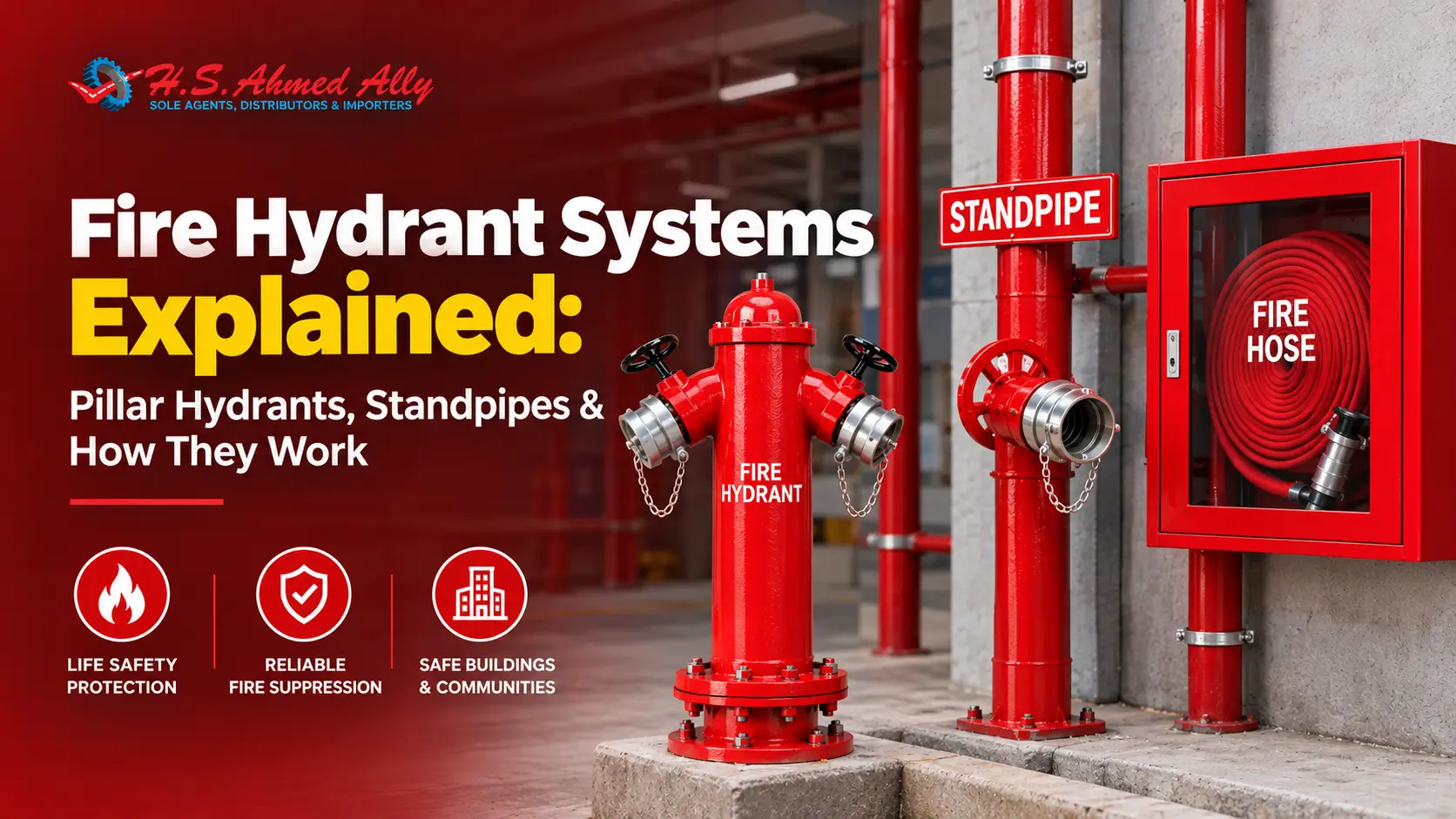
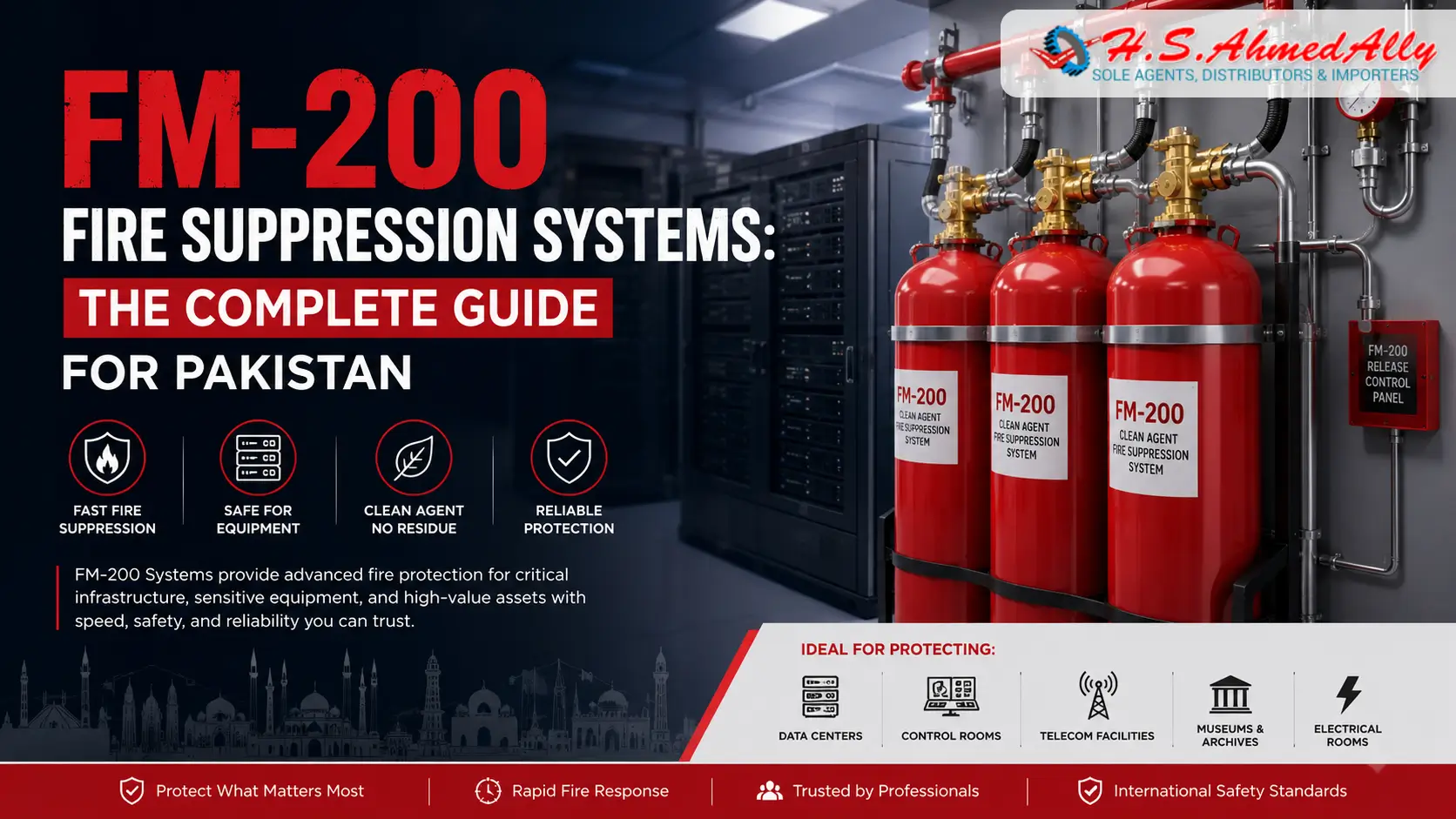
- Other suppression systems for special rooms and equipment. See our Fire Suppression Systems and our guides to FM-200 clean agent systems and kitchen fire suppression
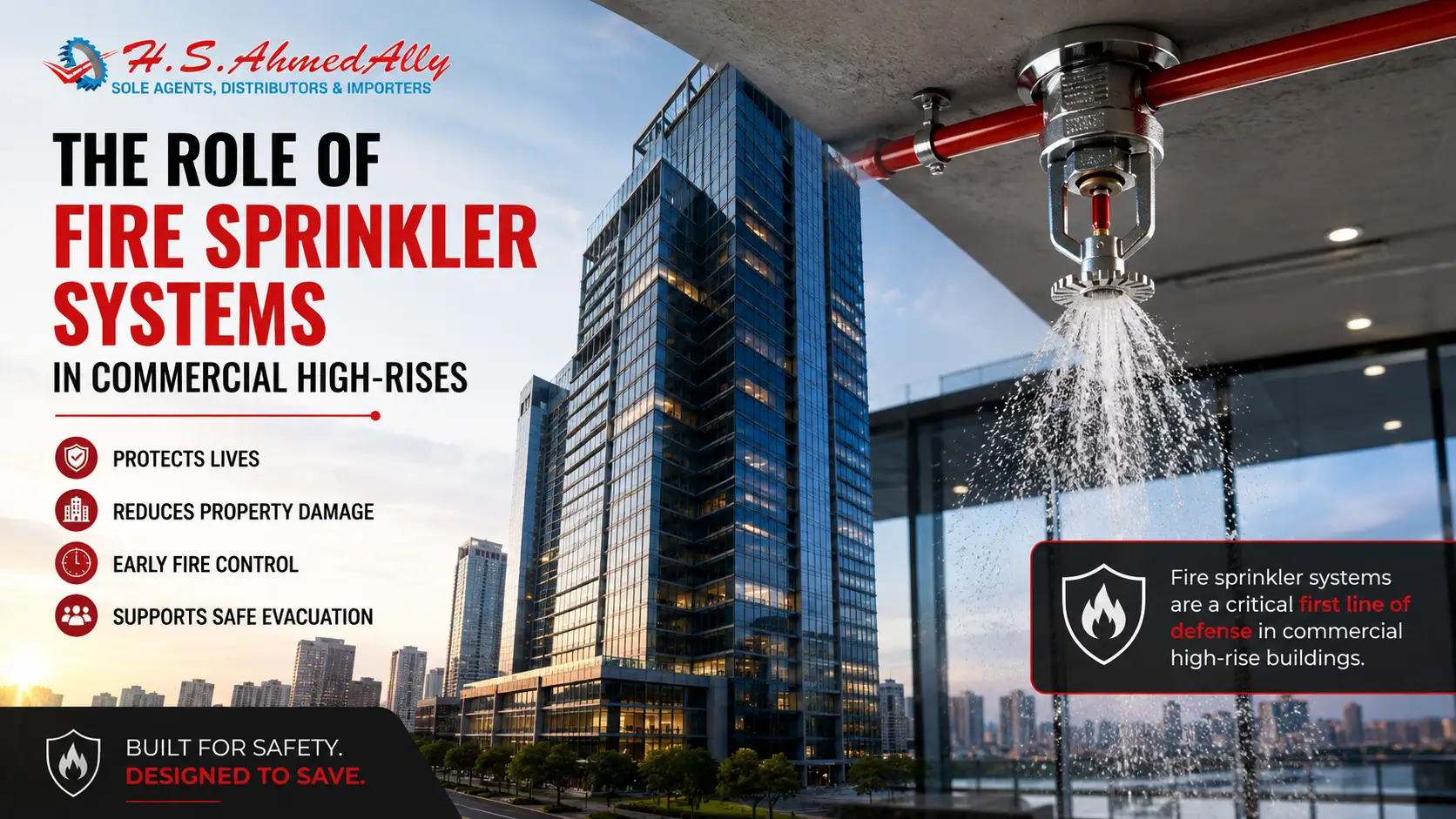
- Sprinklers for buildings. Read about fire sprinkler systems in commercial high-rises
Explore the full range on our Fire Fighting Solutions page.
Why Choose HS Ahmed Ally for Foam Fire Protection?
HS Ahmed Ally has served engineering and fire fighting needs in Pakistan since 1948. We are the authorised distributor of Firex in Pakistan, and we are based in Karachi.
Here is what you get when you work with us:
- A wide foam range. From Firex AFFF to Fomtec UL-listed, ICAO and FFFP concentrates.
- Matching equipment. Pumps, detection, suppression and extinguishers from one source.
- Practical advice. We help you match the foam to your fuels and your site.
- Nationwide supply. We deliver across Pakistan, including Karachi, Lahore and Islamabad.
- Support after the sale. We stay in touch for spares, questions and upgrades.
Frequently Asked Questions
What is a foam fire suppression system used for?
It is used to put out fires that involve flammable liquids, such as petrol, diesel, oil and some chemicals. The foam covers the liquid, cuts off air, cools the fuel and traps the vapour.
Is foam better than water for oil fires?
Yes. Oil and petrol float on water, so water can spread the fire. Foam floats on top of the fuel and seals it. That is why foam is the preferred choice for flammable liquid fires.
What does 3% or 6% foam mean?
It is the mixing ratio. A 3% foam mixes 3 parts of concentrate into 97 parts of water. A 6% foam mixes 6 parts into 94. Your foam strength must match your mixing equipment.
Can one foam work on all chemicals?
No. Standard AFFF works on hydrocarbon fuels. Alcohols and other polar solvents need alcohol-resistant foam. Always check your chemical list with a specialist.
How often should a foam system be tested?
Follow the maker’s guidance and your local rules. In general, you should inspect the system often, test the pump regularly and check the foam concentrate on a set schedule. Keep written records of each check.
Does a small fuel station need a foam system?
It depends on the size and layout. Small sites often rely on foam or dry powder extinguishers for first response. Larger or higher-risk sites may need fixed foam protection. A site review will tell you what is right.
Final Thoughts
A foam fire suppression system is one of the most important safety tools for any site that stores fuel, oil or chemicals. It works because it fits the problem: it floats, covers, cools and seals.
But a good system depends on good choices. Pick the right foam for your liquids. Match the strength to your equipment. Back it up with a strong pump and early detection. Test it. Train your team.
Ready to protect your tanks, plant or warehouse? Explore our Firex Foam System range or contact HS Ahmed Ally for advice on the right foam solution for your site.